LineNow
Use CasesPartnersProcurementSuppliersResources
LoginBook a Demo
LineNow
  • Use Cases
  • Suppliers
  • Pricing
Login
Book a Demo
Line Now Logo
Procurement and supplier operations — simplified.Based in Seattle, WA

Products

  • Purchase order software
  • Purchase order tracking
  • Supplier management
  • Inventory replenishment
  • Procurement platform
  • Supplier catalogs
  • Pricing

Solutions

  • Restaurant purchasing
  • Manufacturing purchasing
  • Central purchasing
  • Dropshipping
  • Regulated purchasing
  • Supplier order intake
  • All purchasing use cases

Integrations

  • Shopify purchasing
  • Square purchasing
  • Lightspeed purchasing
  • QuickBooks Online
  • All integrations

Resources

  • Buying guides
  • Software comparisons
  • Buyer insights
  • All articles
  • Free purchasing tools
  • Free templates
  • Rollout checklist

Company

  • Why LineNow
  • Book a demo
  • Help Center
  • Contact
PrivacyTermsEditorial standards
© 2026 Line Now LLC
Home/Blog/Guides/Central Warehouse Procurement for Multi-Location Retail
Multi-LocationOperator playbook

Central Warehouse Procurement for Multi-Location Retail

Connect branch requests, warehouse fulfillment and external POs while preserving location quantities, transfers and finance-approved allocations.

Jainul Vaghasia/Published May 16, 2026/Updated September 4, 2026/9 min read

For operators

Use this playbook to tighten the buying loop.

LineNow helps teams move from manual ordering and supplier follow-up to a connected workflow for POs, receiving, inventory, and accounting handoff.

Purchase requests and receivingSee How LineNow Works

Contents

  1. Quick answer
  2. What the internal supplier model means
  3. When this model fits
  4. Use requisitions for intent and internal POs for fulfillment
  5. The data model
  6. The accounting question
  7. What the buyer should see
  8. What the warehouse should do with supplier replies
  9. Internal supplier procurement checklist
  10. Where LineNow fits
  11. Related
Back to top

Multi-location retailers often outgrow direct store-to-supplier buying before they are ready for ERP.

The early workflow is simple: each store manager calls or emails suppliers when they need product. It works while the business is small because everyone knows what is happening. Then the business adds locations, a central warehouse, a wholesale catalog, or a finance team that needs cleaner controls. Suddenly the old workflow creates the same problems every week:

  • nobody can see what has already been ordered
  • store managers bypass the central buyer
  • the warehouse learns about demand too late
  • suppliers receive duplicate or conflicting orders
  • accounting has to reconstruct which location should carry the cost

In a recent customer call with a multi-location Shopify operator, the buyer summarized the current state in one sentence:

"We don't have anything in regards to purchasing. They just call whoever their supplier is and say, 'hey, I need five boxes of whatever.'"

The fix is to use the right record at each handoff. A branch can submit a requisition when the central buyer needs to review demand. Once the warehouse agrees to fulfill it, an internal PO or stock-fulfillment record carries the operational commitment.

Quick answer

Central warehouse procurement can use requisitions for branch demand and a separate internal fulfillment or transfer record for stock the warehouse agrees to supply. The warehouse becomes the controlled buying point: it confirms what it can fulfill, consolidates remaining demand, sends supplier POs, manages supplier replies, receives goods, allocates inventory back to stores, and hands accounting location-aware purchase records. This is different from a stock transfer. A transfer moves inventory. A procurement loop records intent, approval, supplier reality, receiving variance, cost allocation, and accounting handoff.

Read before ordering

A dense operator briefing for teams that need sharper buying, cleaner supplier follow-up, and fewer expensive surprises.

What the internal supplier model means

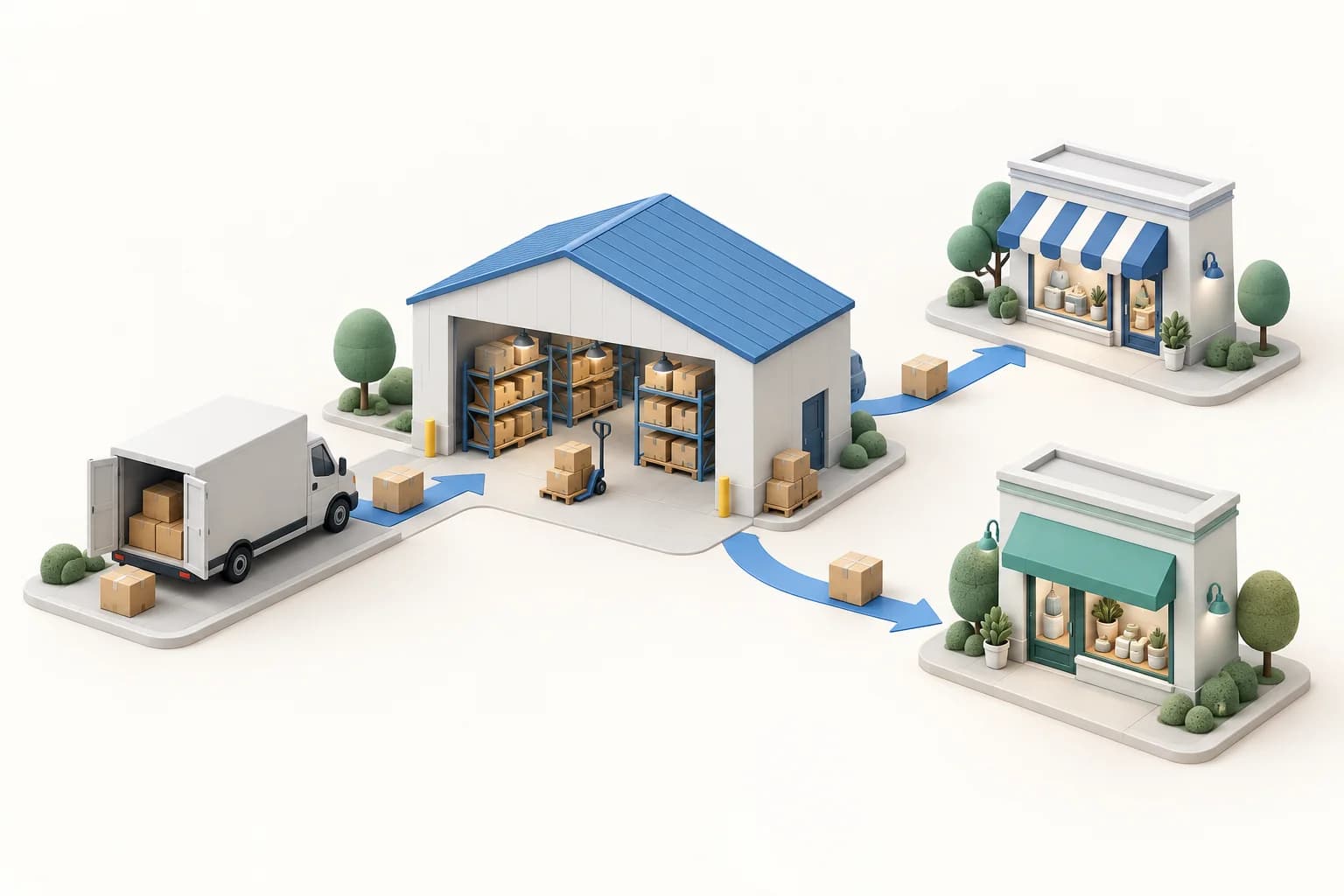
In the internal supplier model, each location places a purchase order to the central warehouse. The warehouse receives those location orders, confirms or adjusts them, consolidates demand, and places external POs with real suppliers.

The store does not need to know whether the warehouse already has product on hand, needs to split the order, or needs to buy more from an outside vendor. The store asks for what it needs. The warehouse controls how that demand is fulfilled.

The workflow looks like this:

  1. Store manager builds an order for the central warehouse.
  2. Warehouse buyer reviews orders from all locations.
  3. Warehouse confirms what it can fulfill from stock.
  4. Warehouse consolidates remaining demand into supplier POs.
  5. Supplier confirms, substitutes, backorders, or changes prices.
  6. Warehouse receives goods and updates the order state.
  7. Stores receive their allocation.
  8. Accounting sees clean purchase records, receipts, and location-level spend.

This is procurement, not just inventory transfer. A transfer moves stock. Procurement records intent, approval, supplier reality, receiving, cost, and accounting handoff.

When this model fits

Consider the internal supplier model when several of these conditions apply; there is no fixed count that establishes fit:

  • multiple stores or branches ordering from shared suppliers
  • a central warehouse or main store that physically receives product
  • a supply chain manager or primary buyer who should control vendor POs
  • store managers who need a simple way to request product
  • internal markup for freight, labor, or corporate overhead
  • a finance team that wants location-level purchasing accountability
  • Shopify, Square, Clover, Lightspeed, or another POS as the sales system
  • QuickBooks Online or Xero as the accounting system

It is common in specialty retail, floral, food service groups, regional wholesalers, franchise-like operators, and businesses that sell both to consumers and to other businesses.

The key signal is this: branch-level demand exists, but supplier authority should be centralized.

Use requisitions for intent and internal POs for fulfillment

LineNow gives SMB operators a distinct requisition without imposing an enterprise procure-to-pay rollout. Approval can trigger for every request, estimated total, item count, or unpriced items. Default or requester-specific approvers send the request to Procurement or return it with a reason.

After approval, the internal PO or warehouse fulfillment record should show what the warehouse committed to supply. External supplier POs should remain separate. This preserves intent, fulfillment, and supplier commitment without collapsing three different states into one document.

They need internal control without turning every order into a finance process. In the customer call, the buyer described the desired flow:

"The store managers put in recs into the system. Those recs then go to our supply chain manager, who will be our primary buyer. He takes all of those recs, turns them into POs and issues those POs to the suppliers."

Where approval is already resolved, stores may use an internal order directly. The warehouse approves, changes, or fulfills those POs. Then the warehouse creates external supplier POs when needed.

That keeps the language operational. Store managers understand purchase orders. Warehouse teams understand incoming orders. Suppliers understand POs. Accounting understands bills and receipts.

The data model

A clean internal-supplier setup usually needs four objects.

Locations. Each branch, store, kitchen, warehouse, or wholesale location should have its own inventory and purchasing view.

Business units. Some businesses need more than location. A florist may want fresh stems, hard goods, and wholesale treated differently. A retailer may want retail stock and dropship catalog items separated. A cafe may want grocery and kitchen inventory separated.

Internal supplier. The central warehouse is modeled like a supplier from the store's perspective. It can receive orders, confirm availability, change quantities, and fulfill.

External suppliers. The real vendors still exist. The warehouse places POs with them after consolidating demand.

The mistake is collapsing all of this into one shared inventory table. Shared inventory answers "how many do we have?" It does not answer "who asked for this, who approved it, what changed, who received it, and which location should carry the cost?"

The accounting question

Multi-location procurement usually creates two accounting questions.

First, how should external supplier bills enter accounting? For many SMBs, the answer is still straightforward: final supplier bills should enter QuickBooks or Xero as bills, with vendor, line items, documents, receipt state, and location or class context where relevant.

Second, how should internal warehouse costs be allocated? Some operators charge branches at cost. Others add a small markup to cover freight, labor, handling, or corporate overhead.

In the customer call, the buyer explained the markup reason clearly:

"We just charge them a slight little markup just to cover overhead basically."

That markup is not a supplier price change. It is internal allocation policy. The procurement system should preserve the distinction:

  • supplier cost: what the outside vendor charged
  • landed or warehouse cost: freight, handling, and receiving cost if allocated
  • internal transfer or charge price: what the branch carries
  • margin or overhead allocation: the difference, if the business uses one

Within one legal entity, an internal transfer or management markup is not an additional external purchase or new group revenue. Intercompany transactions need separate finance-approved rules, including any required eliminations. Verify the exact connector support for location, class or tracking-category allocation rather than assuming one bill can carry every desired dimension.

Even if the first version is simple, the records should be structured enough that finance can answer: which location consumed the spend, which vendor created the cost, and where did the internal markup come from?

What the buyer should see

The central buyer needs a different screen from the store manager.

The store manager should see:

  • the items they are allowed to order
  • what is low or out at their location
  • what they already requested
  • what has been confirmed, shipped, or changed
  • expected arrival timing

The central buyer should see:

  • demand across all locations
  • duplicate requests
  • supplier-level consolidation opportunities
  • open POs and incoming inventory
  • budget or spend by location
  • exceptions that need approval

This is where the internal supplier model becomes powerful. It gives store managers an easy buying path while giving the central buyer control over supplier execution.

What the warehouse should do with supplier replies

The hard part starts after the warehouse sends supplier POs.

Suppliers reply with real-world changes:

  • "This item is out until Friday."
  • "We can substitute this pack size."
  • "Price went up this week."
  • "We can ship half today and half next week."
  • "Invoice attached."

If those replies sit in one buyer's inbox, the location orders drift from reality. The store manager thinks an item is coming. The warehouse knows it is short. Accounting sees a bill that does not match the original PO.

A closed-loop procurement system keeps the order record alive. Supplier replies update the living PO, receiving updates inventory, upstream reconciliation happens before AP, and accounting gets the latest state instead of the original guess.

Internal supplier procurement checklist

Use this checklist before moving a multi-location operation into a central warehouse procurement workflow:

  1. Define each location that can request or receive product.
  2. Decide which products are ordered from the warehouse versus directly from suppliers.
  3. Decide whether the warehouse charges branches at cost or with markup.
  4. Map store managers, central buyers, receivers, and accounting users to roles.
  5. Create supplier records with contact channel, lead time, MOQ, pack size, and payment terms.
  6. Decide what must be received at the warehouse before being allocated to stores.
  7. Decide how QuickBooks or Xero should receive bills, classes, locations, and attachments.
  8. Run a controlled pilot before cutover and designate one sending/receiving owner so parallel record checks do not create duplicate orders or stock.

The first cycle should include the normal loop and one meaningful exception, such as a short warehouse allocation or changed supplier pack. Pick one category, one or two suppliers, and two locations. Send real POs, receive real goods, push or stage the bill, and check whether the records make sense to store operations and accounting.

Where LineNow fits

LineNow is built for this kind of SMB procurement loop: locations, suppliers, POs, supplier replies, receiving, inventory updates, and accounting handoff in one workflow.

For a central warehouse model, the practical setup is:

  • locations or business units for each store and warehouse
  • central warehouse treated as the internal supplier for store orders
  • external vendors attached to the warehouse buyer's supplier roster
  • purchase orders used as the shared record between store, warehouse, supplier, receiver, and accounting
  • supplier replies parsed into order updates instead of buried in email
  • final purchase data pushed or staged for QuickBooks or Xero

The goal is not to make an SMB behave like an enterprise procurement department. The goal is to give a growing multi-location business enough control that store managers stop calling suppliers at random, the warehouse can plan, and accounting stops reconstructing what happened after the month is already closed.

Related

  • Procurement for Specialty Retailers
  • Multi-Location Restaurant Procurement: Location-Level Planning — the restaurant-specific version of this model, with recipe-level demand aggregation and per-location PAR
  • Shopify Plus and QuickBooks Still Leave a Procurement Gap
  • Requisitions vs Internal Purchase Orders
  • 90-Day Procurement Trial Setup for Shopify Plus and QuickBooks
  • Three-Way Matching vs. Living POs
  • Three-Way Matching
  • Why Your Invoice Never Matches Your PO
  • Five Ways to Order with LineNow

Ready to make your warehouse behave like an internal supplier? Book a demo to start your 90-day free trial.

central warehouse procurementmulti-location retail procurementinternal supplier modelintercompany purchasingstore replenishmentQuickBooks procurement

Written by Jainul Vaghasia

Jainul Vaghasia builds LineNow, the purchasing and inventory platform for SMBs. He writes from operator interviews, customer implementations, and the live purchasing workflows LineNow runs for restaurants, retailers, and ecommerce brands.

Editorial standards and corrections

Recommended next

Continue with a relevant guide or purchasing workflow.

Explore the buying process, compare software, or see how a customer handles similar supplier work.

Purchase requests and receivingFollow a purchase request through approval, buying and receipt.Requisitions vs Internal Purchase Orders for Procurement TeamsSeparate a request to buy, internal warehouse fulfillment and an external supplier PO, with operational approvals and accounting boundaries.PricingCheck the trial, business-unit pricing and what is included.
Share on X